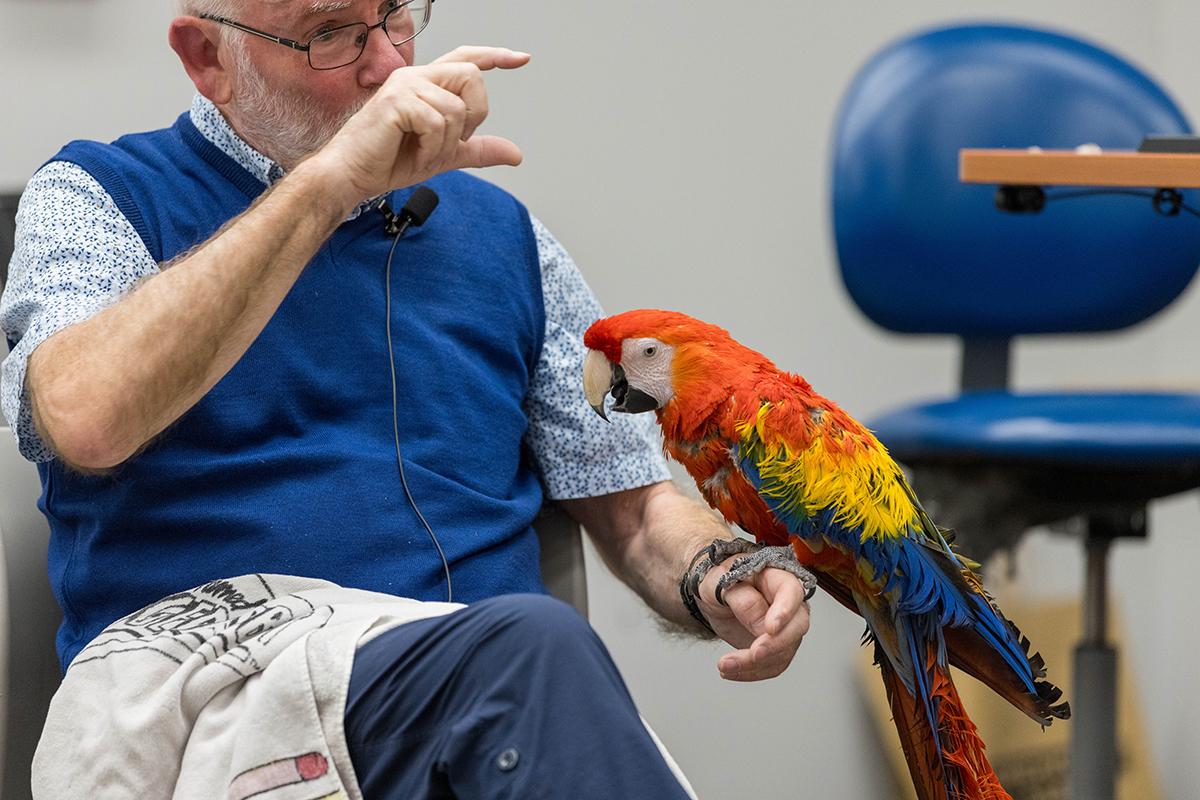
It's comparable to the behavior of children in a classroom with a teacher who feels like they're not being taken seriously. If the children don't feel respected by the teacher, they'll exhibit problem behavior.
The ultimate consequence of undesirable behavior can be the bird disappearing into the trade or being relinquished to a parrot sanctuary. This is a sad situation, as a parrot should be a lifelong companion with its own place within a family.
In general, it can be said that owners of parrots/parakeets are insufficiently informed about the responsible keeping of these birds.
Incorrect information about nutrition, housing and care is still circulating.
Non-domesticated animals
It's not often realized that we're dealing with non-domesticated animals. Non-domesticated animals are animals kept in captivity from the wild. This is very different from keeping domesticated animals like dogs, cats, or horses.
Responsible keeping of non-domesticated animals in captivity requires knowledge of the animal’s background and expertise in approach and care.
It's generally recognized that responsible dog ownership involves, among other things, training the dog to prevent unwanted behavior. For over 40 years, puppy training classes have been offered throughout the Netherlands, where owners spend 10 Saturdays learning how to care for their pets responsibly.
These courses are in the interest of both the pet and the owner. The course is not actually a puppy course, but a course for the owner. After all, it is the owner who has to learn how to handle a dog. Dogs are pets that have been kept by humans as (companion) animals for many thousands of years. Dogs were bred to be kept as pets and do not exist in the wild as a species. In that sense, it is very "natural" to keep a dog as a domesticated pet..
Behavioral consultation for parrots and parakeets
Parrots/parakeets, as non-domesticated animals, have only recently been kept as pets. It is actually not common practice to keep these birds as pets.
Keeping these birds is only responsible if the owner has the necessary knowledge of their dietary, housing, care, and training/behavior requirements. Since 1982, the Bird Advisory Practice has focused on addressing behavioral problems and unwanted behavior in captive parrots and parakeets. For many years, courses on this topic have been offered, lectures presented at international conferences, and guest lectures have been given at universities in the USA, South America, and Europe.
Behavioral consultations are similar to puppy training. The difference with puppy training is that with parrots/parakeets, the majority of behavioral consultations focus on resolving existing problems. Therefore, behavioral consultations are primarily intended to identify mistakes/errors made/being made in handling the birds.
The behavioral consultation is primarily intended to influence and change the owner's behavior. It's important that the owner learns to recognize that they are partly responsible for the undesirable behavior.
Such behavioral consultations are generally very intensive. Sometimes even confrontational, as the owner must be reminded of their ignorance of a parrot's/parakeet's normal behavior. Responding incorrectly to a parrot's behavior creates a negative, vicious cycle. Expectations often also need to be adjusted.
It is an illusion to think that a behavioral problem can be solved within a one-hour behavioral consultation. Initially, a significant portion of the time is spent assessing and discussing the owner's insecurities, ignorance, and mistakes regarding handling and approaching the parrot. In addition, other aspects of "keeping" a parrot/parakeet are discussed. Ensuring the birds' welfare is the constant goal to strive for.