Go to main content of this page.

Course 'Loving' parrots and parakeets

"You also go to puppy training with a dog, right? Why not with a parrot or parakeet?"

It is known that dogs are intelligent and understand more than many people think, and that is partly why almost every dog ​​owner takes a course. Good puppy training focuses on intelligence, among other things, with the result that the dog becomes a positive part of the family.

Thanks to the years of research by Dr. Irene Pepperberg to the intelligence of parrots, we know that parrots have the intelligence level of a 6-7 year old child and parrots understand the same as what children from 6 to 7 years understand. Underestimating intelligence and cognition in parrots has the same consequences as not taking children seriously.

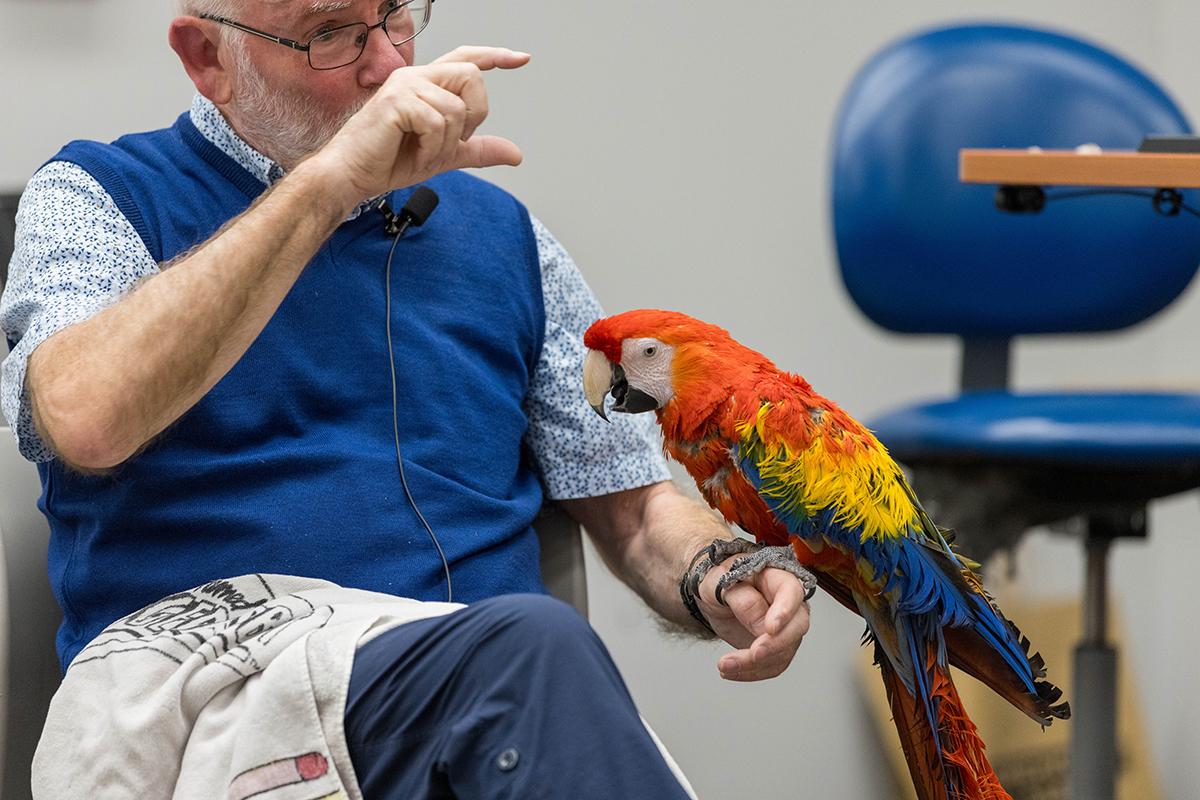
In the behavioral course we teach you, among other things, how to respond to intelligence and cognition and how to reward this.

register immediately

Why a behavior course for parrots and parakeets?

In addition to their high intelligence, parrots and parakeets are very social, non-domesticated animals, which makes keeping parrots much more complicated than keeping a dog as a domesticated pet. Without the necessary guidance and knowledge, things usually go wrong and significant problems arise. This includes problem behavior such as plucking, screaming, biting, partner behavior, unfamiliarity, etc. Ultimately, both the bird and the owner are unhappy.

The term 'Loving' in the title is therefore deliberately placed between quotation marks. Love for animals often expresses itself in the wrong way, for example, animals are treated as a kind of teddy bear/lap dog, as a result of which the animal experiences no respect, resulting in behavioral problems. Parrots/animals have an interest in experiencing that they are treated with respect. How we show respect for the parrot is an important part of the course day.

As a (new) parrot or parakeet owner, do you want to prevent problems, or do you notice that behavioral problems are slowly developing, or do you doubt the health of your parakeet or parrot?

Then take our course now and learn the basic principles to better understand and care for your pet. The 'Loving' parrots and parakeets course is intended for owners of parrots and/or parakeets and animal caretakers, but is certainly also very relevant for interested veterinarians, paraveterinarians, veterinary students and animal caretakers, whether or not in training.

By following the course, health problems, behavioral problems and welfare problems can be prevented.

The course can be taken in groups but also individually.

A number of dates have been set on which the course will take place in groups at various locations in the Netherlands. You can view the planning in the agenda, where you can also register directly.

Other wishes?

Would you rather take the course individually, or would you like to take this course with a group of colleagues, acquaintances or friends at a location of your choice? That is also possible. Please complete the contact form and Jan will contact you to plan a suitable date together.

get in touch


Practical information

  • Trainer: Adviespraktijk voor Vogels - drs. J. Hooimeijer
  • Duration: the course lasts 1 day (van 09.30u tot 17.00u)
  • Costs: € 90,- p.p.*

*Family and friends discount: Second participant €65, Students: €25,

  • Included: The courses include coffee, tea, lunch, study material (digital) and certificate.
  • Location:
    Vergaderruimte bij Bakkerij Stoet
    Rijksstraatweg 32
    9756 AG Glimmen

Wil jij ook het beste voor jouw papegaai of parkiet?

Then register now!

Enrol


What will be covered during this course?

  • What makes parrots and parakeets special as pets and as patients?
  • They are non-domesticated, intelligent, social, and prey animals.
  • How healthy is my bird? What should we pay attention to and how can we prevent problems?
  • Nutrition, housing, and care.
  • Expertise is required to ensure health and well-being.
  • The behavior of parrots and parakeets in the wild and in captivity.
  • How intelligent are parrots and parakeets? How do we deal with this?
  • How do we respond to cognitive processes?
  • Definitions of normal behavior, desired behavior, undesirable behavior, forced behavior, and displacement behavior to recognize and understand behavior and how best to respond to it.
  • How do we prevent undesirable behavior, how do we deal with undesirable behavior, and how do we resolve undesirable behavior?
  • Behavioral problems such as insecurity, screaming, biting, plucking, "hormonal behavior," and shyness.
  • Why not on the shoulder? The 5-step behavioral protocol, a tool for building mutual respect and trust.
  • Why a separate sleeping area?
  • Parrots don't bite children.
  • Why is hand-rearing parrots prohibited in the Netherlands?

What's in it for me?

By taking the course, you'll get to know your bird better and learn how to handle different situations. You'll also learn to understand your own behavior and see it through the eyes of the parrot. This way, you'll experience how your own behavior influences the bird's behavior.

The starting point of the course is to create mutual trust, so that the parrot or parakeet truly becomes part of the family and can remain within the family even if the owner dies.

I want that too!